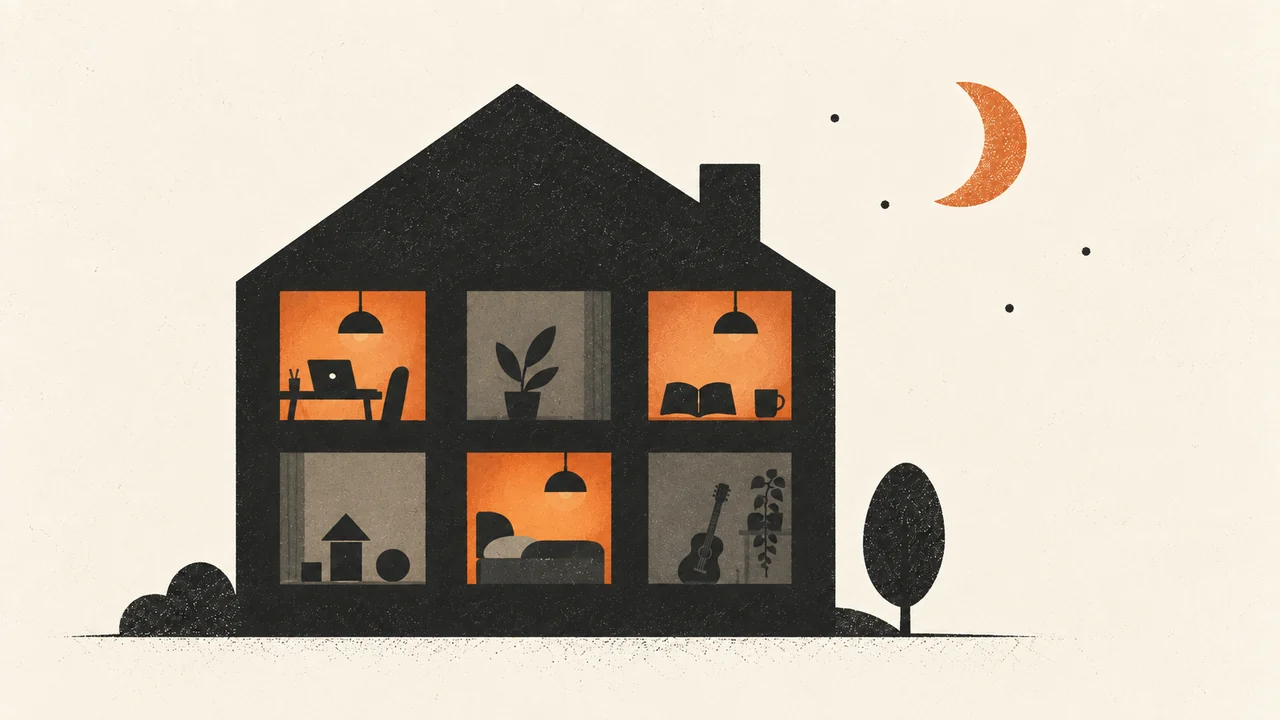
I used to think that at some point life would become less busy.
Work would calm down.
The house would finally be finished.
There would be a free weekend.
A few quiet evenings.
Then I would read more, write more, improve my Dutch, go deeper into technical subjects, work on old computers and finally get around to all the things I kept postponing.
That period never came.
Instead, I got married, became a father, moved to another country, bought a house, continued building my career, started restoring old computers, created this website and somehow kept finding new things I wanted to learn.
We also have Java, our dog, who has his own schedule and makes sure that going outside is never optional.
There is always something.
At some point I realised that waiting for life to become quieter was itself a way of postponing things.
You have to learn to continue while life is full.
Nothing is ever really done
This is probably the most accurate description of my life:
Nothing is ever done.
At work, you solve one problem and another appears.
You fix something in the house and notice the next thing.
I publish an article and immediately see something on the site that I want to improve.
An old Macintosh starts working again, but it still needs cleaning, a part, better photos or another test.
I learn something technical and discover three subjects underneath it that I do not understand well enough.
My English can improve.
My Dutch definitely can.
Even the house seems to maintain its own backlog.
There is never a moment where everything reaches Done.
For someone who has spent years working with tickets, projects and releases, this can be surprisingly uncomfortable.
We are trained to finish things.
Real life does not seem particularly interested in that idea.
I have become more comfortable with the fact that many parts of life are not projects with an end date.
They are things you return to.
Most of my time already belongs to something
A normal weekday is not very mysterious.
There is work.
Then there is family.
Dinner, cleaning up, preparing things for the next day, walking Java and whatever small task the house has invented for us.
And, most importantly, there is Atlas.
After work, when he is awake, I want to be with him.
Weekends belong to him even more.
We usually plan them around doing something together, going somewhere, playing, walking or simply staying at home as a family.
I know this part of life is temporary.
One day he will have his own plans and will not be particularly interested in spending the whole weekend with us.
So I do not see time with him as something that gets in the way of my projects.
It is part of the life I am trying to build.
That means the other things usually happen around the edges.
After bedtime.
During a quiet hour.
Sometimes for thirty minutes.
Sometimes not at all.
My version of discipline is boring
When people talk about discipline, it often sounds dramatic.
Wake up at 5:00.
Never miss a day.
Follow the routine.
Remove every distraction.
I have never lived like that.
My version is much less impressive.
Sometimes it means opening the laptop after Atlas goes to sleep and spending forty minutes reading about something technical.
Sometimes I do a little Dutch.
Sometimes English.
Sometimes I write part of an article.
Sometimes I work on this website.
I rarely have an enormous uninterrupted block of time.
And I am not consistent in the Instagram sense of doing exactly the same thing at exactly the same hour every day.
What I am fairly good at is coming back.
If I miss a few days of Dutch, I start again.
If I do not write for two weeks, I eventually open the draft again.
If a technical subject becomes difficult, I may leave it for a while, but I rarely consider that the end of it.
For me, that is discipline.
Not maintaining a perfect streak.
Returning.
Thirty minutes is enough to keep something alive
Thirty minutes does not feel important.
That is why it is so easy to waste.
It feels too short to start anything serious.
But a surprising amount of my life has been built in periods that did not feel long enough.
A few paragraphs of an article.
A chapter of a technical book.
Some Dutch practice.
Research into a problem I saw at work.
A small change to this site.
Cleaning one part of an old computer.
None of these sessions feels significant while it is happening.
But six months later, they add up.
I think software engineering taught me this without me noticing.
Ten years of experience does not arrive as one big achievement.
It is thousands of small moments where you decide to understand something a little better than you did before.
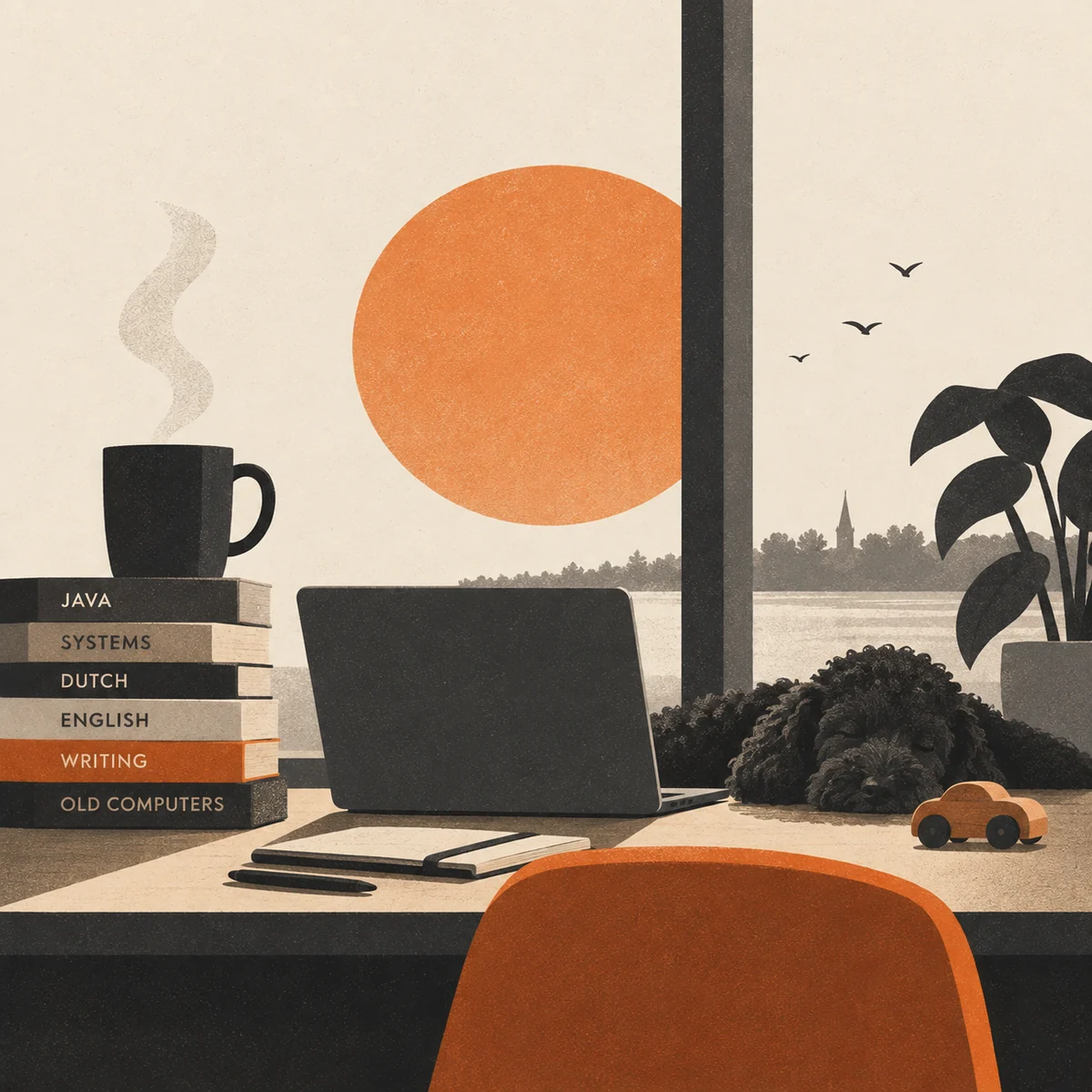
Working from home gave me better edges
Working from home helps.
There is no point pretending otherwise.
I remember commuting in Istanbul and trying to make those hours useful.
I would read, watch something or learn while travelling.
But commuting time still belongs to commuting.
You are between two parts of your life.
Today I can finish work and already be home.
I can have lunch with my family.
I can walk Java during the day.
There is less dead space between work and everything else.
What surprised me is that having more usable time does not automatically make you use it well.
I can have a completely free evening and achieve nothing.
I can also have forty minutes and learn something useful.
Time helps.
But at some point you still have to sit down and begin.
I do not try to keep everything moving
I have too many interests to work on all of them every week.
Software.
Writing.
Old computers.
Languages.
The house.
Reading.
Learning whatever has caught my attention recently.
I used to think I needed a better system to balance them all.
Now I mostly let my attention move.
There are periods where I spend far more time on this website.
Other times I am reading deeply into an engineering subject.
Sometimes I become more serious about Dutch or English.
Sometimes OldByte takes over a few evenings.
And sometimes the house wins.
I no longer expect all of these things to move forward at the same speed.
That would turn my personal life into another Jira board.
The focus can change.
What matters to me is that curiosity and learning remain part of my life over the long term.
Curiosity starts things. Discipline gets through the boring part.
Starting is usually easy for me.
I am curious about too many things.
If I do not understand something, I want to know how it works.
That can be Java, distributed systems, an old Macintosh, a language, the heating system in the house or some completely unrelated thing that caught my attention.
The beginning is fun.
Then eventually you reach the part that is not fun.
The documentation nobody wants to read.
The grammar rule you keep forgetting.
The problem that refuses to make sense.
The third attempt at fixing something you thought would take ten minutes.
That is where curiosity is no longer enough.
You need enough discipline to stay with it.
Not because everything must be completed.
Just because some things deserve more than an enthusiastic beginning.
Family changed what consistency means
Before becoming a father, I had much more control over my time.
I could decide that Saturday was mine and spend most of it doing whatever I wanted.
That is obviously different now.
Atlas may need us.
Java needs a walk.
My wife and I need time together.
Something comes up.
Plans disappear.
I do not see that as a failure of discipline.
Consistency has to work with the life you actually have.
Some weeks leave plenty of space.
Others leave almost none.
There are evenings when I can spend hours learning or writing because my wife makes that possible.
There are other evenings when the right thing to do is close the laptop.
And there are evenings when we sit on the sofa, drink coffee and talk.
Nothing gets produced.
Those hours are still some of the most valuable ones.
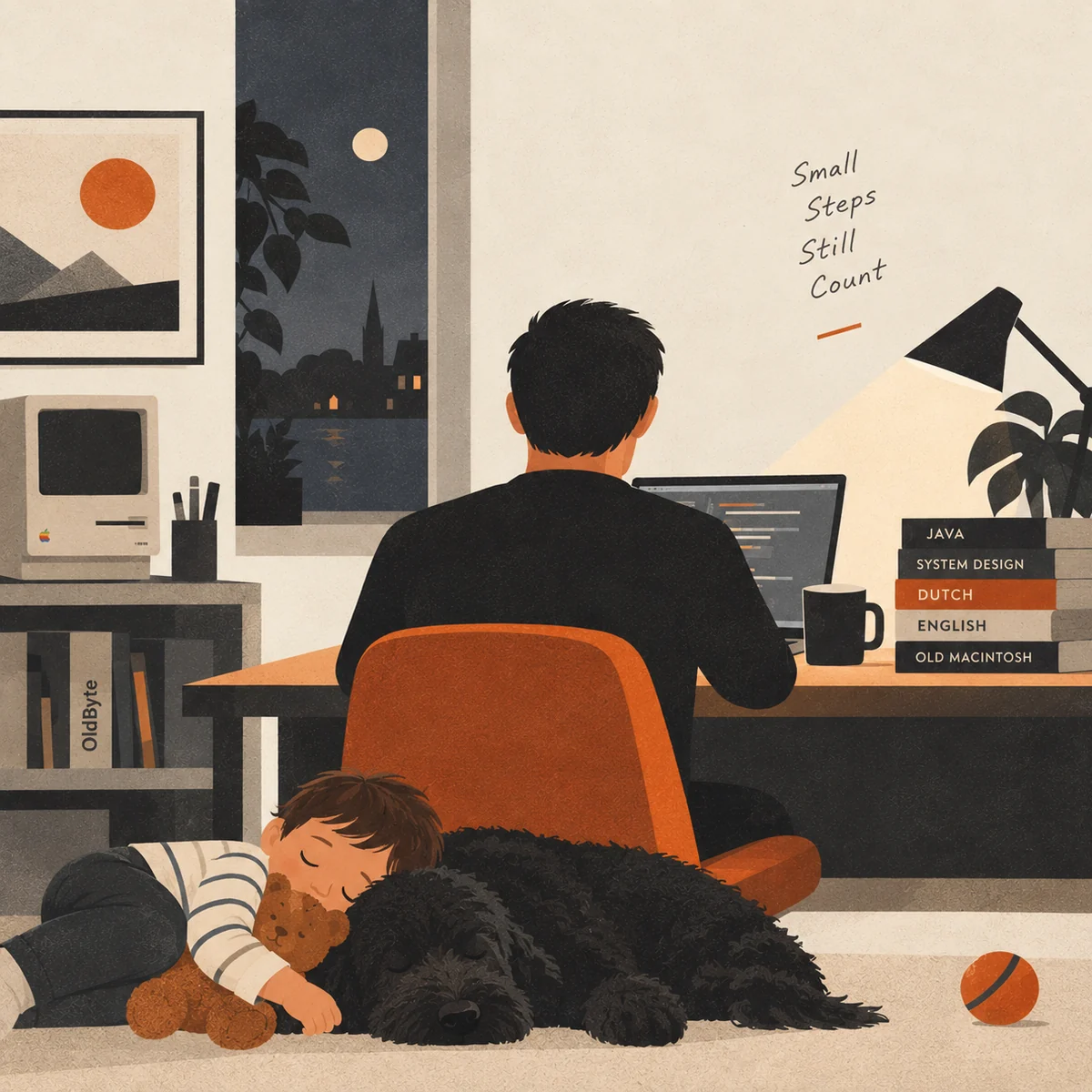
Not every minute needs a purpose
I have no interest in turning every free minute into a productivity exercise.
A walk with Java does not need to become podcast time.
Sitting on the sofa does not need to become recovery optimisation.
A hobby does not need to become a business.
Sometimes doing nothing is exactly what I want to do.
The difference, for me, is whether I chose that or whether weeks quietly disappeared while the things I said mattered to me stayed permanently postponed.
Resting tonight is fine.
Always starting next Monday is something else.
That distinction has become more important as I have got older.
Life is not going to clear the calendar for me
I think this is the main thing I understand differently now.
There will always be work.
Atlas will need us.
Java will need walking.
The house will find something else.
There will be appointments.
Some weeks will be difficult.
I will be tired.
And there will always be far more interesting things to learn than I have time for.
This is not a temporary scheduling problem.
This is the schedule.
So I try to keep moving inside it.
Sometimes I make a lot of progress.
Sometimes thirty minutes is enough.
Sometimes I stop for a while.
Then I come back.
I do not think discipline is doing everything.
I do not even think it is doing something every day.
For me, it is refusing to permanently abandon the things I decided matter to me just because life became busy.
Because in my life, nothing is ever completely done.
And apparently, neither am I.