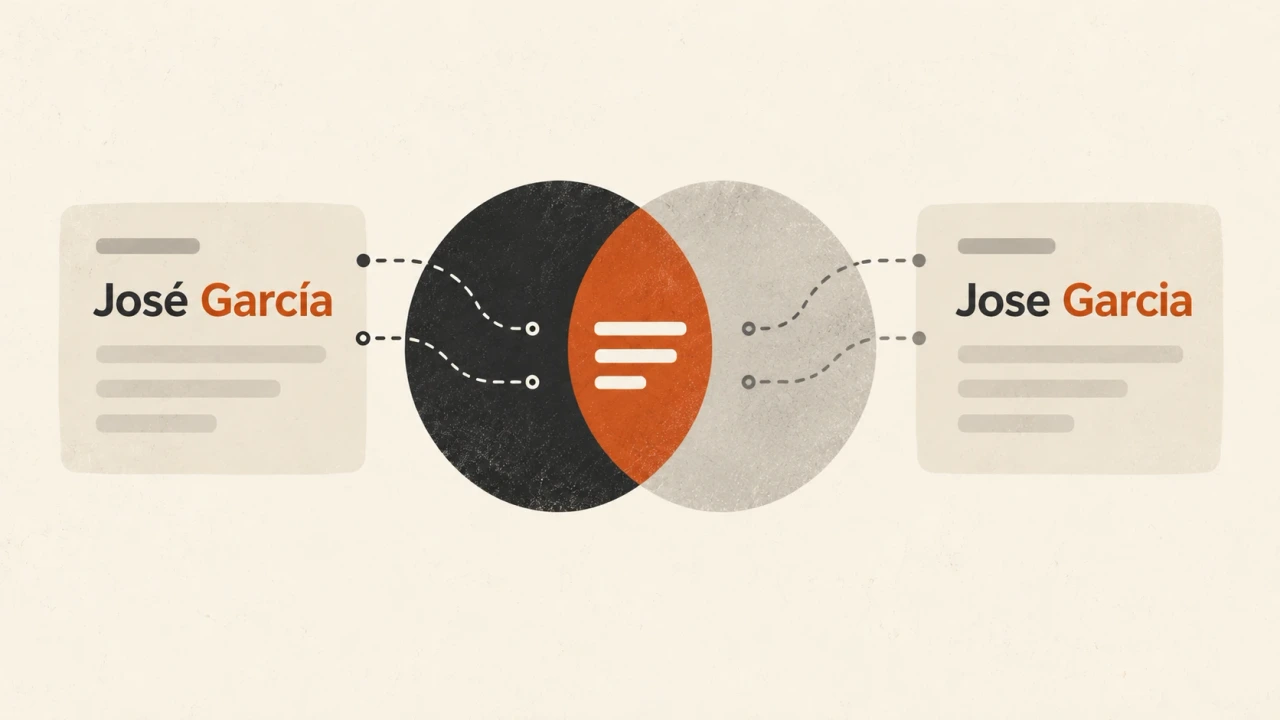
Why a simple string comparison becomes a difficult engineering problem when names cross languages, cultures, and systems.
Imagine you're building an identity verification system. A customer registers as José García, but a document provider returns Jose Garcia. A basic string comparison says the names differ, even though a human would recognize a familiar accent variation.
So you remove accents. Then Müller arrives as Mueller, and your fix no longer helps. Next, Robert Johnson appears as Bob Johnson. Eventually, names arrive in scripts your original database forms never anticipated.
None of these differences necessarily means the data is wrong. The same name can have multiple legitimate representations. That is what makes name matching an interesting engineering problem: we are not just comparing characters; we are interpreting imperfect evidence.
And the difficult decisions begin long before we calculate a similarity score.
Similar names are not necessarily the same person
There are three different questions hiding behind the word match: Are these strings identical? Are these names similar? Do they belong to the same person?
An equality operator answers the first. A fuzzy matching algorithm can help answer the second. Neither can independently establish the third.
Consider John Smith and Jon Smith. Their strings are similar, but they might describe different people. Robert Johnson and Bob Johnson have less similar first names, but Bob can be a nickname for Robert. Neither example proves identity.
That distinction matters in systems handling identity verification, account access, or financial transactions. A similarity score is evidence, not a probability of shared identity. Identity proofing requires more than matching names.
The world does not follow one naming convention
A form with firstName, middleName, and lastName fields may look universal. Real naming practices are not.
Turkey: case conversion is not universal
Turkish distinguishes dotted and dotless I: i, İ, ı, and I. In Turkish uppercase mapping, ilker becomes İLKER, while ışık becomes IŞIK. Java's Locale.ROOT is intentionally locale-independent; it does not implement Turkish-specific casing. Removing marks can also erase distinctions that matter to the original spelling.
This does not mean every Turkish name requires a different matching engine. It means case conversion and accent removal must be deliberate comparison policies, not irreversible changes to the source data.
The Netherlands: surnames can contain prefixes
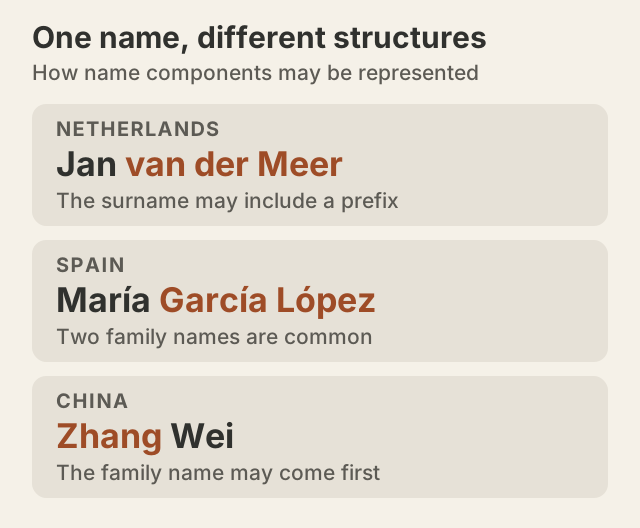
In Jan van der Meer, the surname can be van der Meer, not just the final token Meer. Different forms and providers may store prefixes in separate fields or as part of the family name. Splitting a name at the last space can therefore corrupt its meaning.
Spain and parts of Latin America: multiple family names
A record might contain María García López, while another contains María García. One may be incomplete rather than contradictory. Yet sharing García alone cannot establish that two records refer to the same person. Missing components and conflicting components should not be treated as equivalent.
Portugal and Brazil: component boundaries vary
A name such as Ana Maria Costa Silva may be stored as one full name or split into given- and family-name components. Portuguese-language naming practices can include multiple family names and varying choices of which names are used in everyday contexts. Assuming the last token is always the only relevant surname loses information.
China and Korea: do not assume given-name-first order
Zhang Wei may represent a Chinese family name followed by a given name. International forms can reorder those components, preserve the original order, or split them into fields. Korean names introduce similar order considerations. Automatically swapping every two-token name is just as unsafe as never accounting for order at all.
Arabic names: transliteration is not a unique mapping
Muhammad, Mohammed, and Mohammad are familiar Latin-script variants associated with an Arabic name. They are not the result of simple accent removal. Transliteration across scripts can be ambiguous and non-reversible, and similar spellings alone still do not prove shared identity.
These are not country-wide rules. Language, source system, and individual preference are more informative than nationality alone. The W3C guide to personal names explains why fixed given-name/family-name assumptions are risky.
Normalization is a first step, not a solution
A comparison representation can remove selected differences while retaining the original input separately. Here is a deliberately limited Java example for many Latin-script cases:
import java.text.Normalizer;
import java.util.Locale;

public static String comparisonKey(String name) {
    String decomposed = Normalizer.normalize(
        name, Normalizer.Form.NFD
    );

    return decomposed
        .replaceAll("\\p{M}+", "")
        .toUpperCase(Locale.ROOT)
        .replaceAll("(?U)\\s+", " ")
        .trim();
}
NFD applies canonical decomposition, so a precomposed é and an e followed by a combining accent become the same sequence. Removing combining marks is a separate, lossy operation. The (?U) flag makes Java's \s recognize Unicode whitespace, including non-breaking spaces; it does not remove zero-width characters. This example maps José to JOSE, but it does not turn Müller into Mueller or Łukasz into Lukasz. Nor does it implement Turkish-specific casing or transliteration across scripts. It assumes non-null input, and it is not a production name parser.
There is a less obvious implementation detail: a Java String is a sequence of UTF-16 code units, not necessarily a sequence of user-perceived characters. A character outside the Basic Multilingual Plane occupies two code units; a displayed grapheme can contain multiple Unicode code points. Consequently, edit distance based on charAt() is not automatically a linguistically meaningful character distance. For multilingual matching, the unit of comparison—code units, code points, or grapheme clusters—must be defined and tested. Unicode UAX #29 describes grapheme segmentation.
Preserve original names and version the comparison strategy. Do not silently change historic evidence when a normalization rule is updated.
A similarity algorithm is a choice, not a default
Levenshtein distance counts the minimum single-character insertions, deletions, and substitutions needed to turn one sequence into another. For JOHN and JON, deleting H gives a distance of 1.
One possible normalized similarity is:
S(a, b) = 1 - d / m

d = distance(a, b)
m = max(length(a), length(b))
For JOHN and JON, that gives 1 - 1/4 = 0.75. The length and distance must use the same unit of comparison, and the empty/empty case needs an explicit definition. This score describes strings, not the probability of shared identity.
But Levenshtein is not the only reasonable option. Different algorithms capture different error patterns:
| Technique | Useful for | Important limitation |
|---|---|---|
| Levenshtein | Insertions, deletions, substitutions | An adjacent transposition counts as two edits |
| Transposition-aware edit distance | Swapped adjacent letters | Still does not understand aliases or name structure |
| Jaro–Winkler | Some short-string spelling variations; matching prefixes | Prefix preference can be undesirable or misleading |
| Token/component comparison | Missing middle names, differently ordered components | Depends on reliable parsing and field semantics |
| Alias/transliteration rules | Known linguistic variations | Rules can be ambiguous and need careful governance |
Take MARTHA and MARHTA: standard Levenshtein distance is 2, while an adjacent-transposition-aware distance can count the swapped T and H as 1. That doesn't make the second metric universally better; it simply encodes a different assumption about likely data-entry mistakes.
The practical question is not Which similarity algorithm is best? It is Which errors occur in our inputs, and which mistakes can our business tolerate?
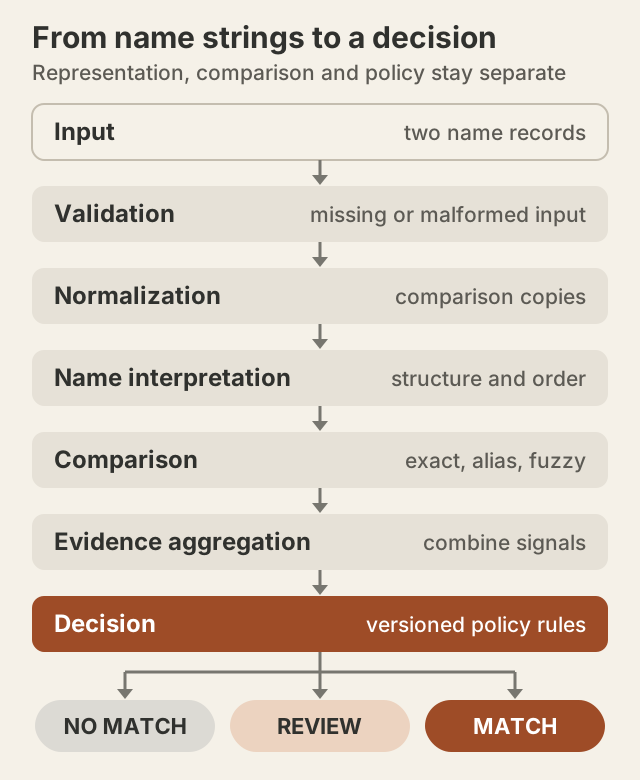
From two names to an explainable comparison
The pipeline is easier to understand when we follow a single pair from input to evidence.
Suppose the registration record contains José García, while a document response contains Jose Garcia.
First, preserve both original values. Then create comparison keys. With the limited normalization function above, both become JOSE GARCIA. Their normalized edit-distance similarity is 1.0, so we have an exact normalized-name match.
That is a useful signal. It is still not proof that the document belongs to the applicant.
Now consider a different pair: John Smith and Jon Smith. Comparing components separately gives JOHN versus JON a similarity of 0.75, and SMITH versus SMITH a similarity of 1.0. Under a hypothetical 40/60 weighting:
Given-name score  = 0.75
Family-name score = 1.00

Combined score = 0.40 × 0.75
               + 0.60 × 1.00
               = 0.90
A combined score of 0.90 is evidence to feed into a decision policy, not a reason to approve the match automatically. And 40/60 is an illustrative choice, not a recommended configuration.
The following small Java function shows one way to compute normalized edit similarity over Unicode code points, rather than raw UTF-16 char values:
static double editSimilarity(String left, String right) {
    int[] a = left.codePoints().toArray();
    int[] b = right.codePoints().toArray();
    int longest = Math.max(a.length, b.length);
    if (longest == 0) return 1.0;

    int[] prev = new int[b.length + 1];
    for (int j = 0; j <= b.length; j++) prev[j] = j;

    for (int i = 1; i <= a.length; i++) {
        int[] curr = new int[b.length + 1];
        curr[0] = i;
        for (int j = 1; j <= b.length; j++) {
            int substitution = a[i - 1] == b[j - 1] ? 0 : 1;
            curr[j] = Math.min(
                Math.min(curr[j - 1] + 1, prev[j] + 1),
                prev[j - 1] + substitution
            );
        }
        prev = curr;
    }
    return 1.0 - (double) prev[b.length] / longest;
}
This is an educational implementation, not a complete matching service. It requires caller-side input validation, has quadratic time in the input lengths, and does not segment grapheme clusters. Real systems also need field parsing, versioned normalization, known aliases, explainable evidence, and a separate decision policy. Libraries such as Apache Commons Text provide established algorithms when their semantics fit the requirement.
Why a single score hides important differences
Compare John Michael Smith with John Smith. A full-string algorithm penalizes the missing middle name, although the available given and family names agree. Compare John Smith with James Smith: the family name agrees, but the given name differs.
Component-level comparison makes these differences visible, but it also raises data-quality questions. Was a component genuinely absent, or did an external provider combine fields? Does the family-name parser understand particles like van der? Are two sources using the same naming convention?
Treat missing evidence, conflicting evidence, and matching evidence as different states. Assigning missing components a similarity of zero can produce false negatives; assigning them a perfect score can produce false positives. A component should not be weighted as if it were observed when it was not.
The dangerous comfort of a threshold
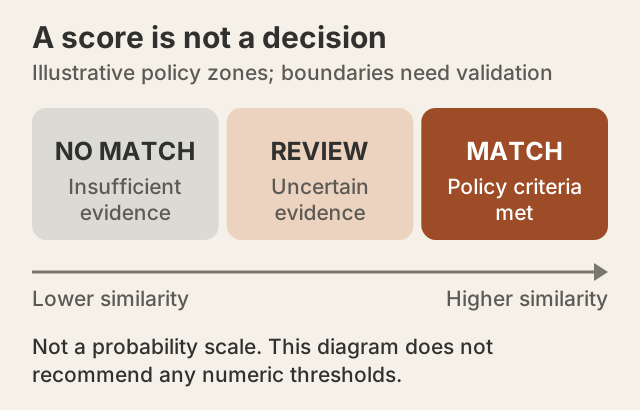
A rule such as score >= 0.90 → MATCH is easy to implement. But 0.89 is not suddenly a different kind of evidence from 0.90.
A false positive matches different people; a false negative fails to match the same person. Their costs differ across applications. An approximate search feature and identity verification should not necessarily optimize for the same trade-off.
To choose thresholds, test a policy on labeled examples whose true match/non-match status was established independently. Here is a fictional evaluation, not a benchmark or a recommended threshold. Assume 100 true matching pairs and 900 true non-matching pairs, with no manual-review zone in this particular table:
| Auto-match threshold | True matches accepted | Non-matches accepted | Precision | Recall |
|---|---|---|---|---|
| 0.80 | 90 | 30 | 75.0% | 90.0% |
| 0.90 | 80 | 5 | 94.1% | 80.0% |
| 0.95 | 70 | 1 | 98.6% | 70.0% |
Precision here is TP / (TP + FP); recall is TP / (TP + FN). Increasing the threshold improves precision in this invented example, but misses more true matches. And even 98.6% precision could be insufficient if the consequences of a false automatic match are severe.
A real system may use MATCH, REVIEW, and NO MATCH, measuring the review rate and what happens after review as well as precision and recall. The useful threshold depends on observed costs, the population, how candidate pairs were selected, and how reliable the labels are. If you change normalization or scoring, you must re-evaluate the thresholds.
What changes when you have a million records?
So far, we've compared two known records. Duplicate detection and entity resolution add a different problem: which records should we compare in the first place?
With one million records, exhaustive all-pairs comparison would require:
1,000,000 × 999,999 / 2
  = 499,999,500,000 pairs
Nearly 500 billion candidate pairs is a compelling reason not to run fuzzy comparison against every record.
Record-linkage systems therefore use candidate generation, often called blocking or indexing. They might retrieve plausible pairs using reliable, permissible attributes, then apply the more expensive similarity logic only to those pairs.
But blocking creates its own trade-off. Block on an exact surname and García/Garcia may be recoverable after normalization, while Müller/Mueller or different family-name orderings may still fall into different groups. A pair excluded during candidate generation never reaches your excellent fuzzy matcher.
In practice, teams may combine multiple complementary blocking keys or retrieval strategies, and evaluate candidate-pair recall separately from final decision quality. The right keys depend on what data may legitimately be used, on privacy constraints, and on the error patterns in the actual population.
This is also an important architectural distinction: if the caller supplies exactly two names, candidate generation is unnecessary. If you're searching a large dataset for possible matches, it becomes a core part of the design.
Production readiness means measuring the whole policy
It is straightforward to unit-test JOHN against JON. It is much harder to know whether your production policy makes acceptable decisions across languages and input sources.
A useful evaluation dataset should contain independently labeled positives, realistic hard negatives (different people with similar names), aliases, transliterations, missing components, and records from relevant regions and providers. Randomly pairing unrelated names creates easy negatives and can make precision look better than it will be in a real candidate set.
Keep evaluation identities separated from development data, so variations of the same person do not leak between tuning and testing. Measure precision, recall, false-positive and false-negative rates, the proportion sent to manual review, and—when candidate generation exists—retrieval recall. Examine those metrics by source, language/script, and missing-data pattern where sample sizes and privacy requirements allow meaningful analysis.
Production monitoring should track policy versions, reasons for review, changes in decision distributions, and latency—not raw personal names in ordinary application logs. If a new normalization library or alias dictionary changes the results, replay a representative, properly protected test set before rollout. A feature flag or staged rollout can make that change safer.
A useful internal result can record why a comparison was handled a certain way:
{
  "decision": "REVIEW",
  "similarityScore": 0.87,
  "strategy": "WEIGHTED_FUZZY",
  "aliasApplied": false,
  "ruleVersion": "v3"
}
This is an illustrative result shape, not a standard API. In high-impact workflows, keep name-comparison decisions separate from actual identity-verification decisions, and provide a review route when the evidence is not sufficient.
Final thoughts
Name matching begins with a simple question: Do these names match? But the engineering challenge extends far beyond edit distance.
Names are linguistic and cultural data. Systems store them inconsistently. Similarity algorithms encode assumptions about spelling differences. Blocking decides which candidate pairs even get a chance to be compared. Thresholds turn imperfect evidence into operational decisions, and every change to the pipeline can shift the errors we make.
A good implementation does not pretend that a single algorithm or score solves the problem. It preserves original information, measures each stage, makes uncertain cases explicit, and keeps decisions explainable and testable.
The goal is not to make two names look the same. It is to make reliable decisions while understanding why they might look different.
Further reading
- Unicode Standard Annex #15 — Unicode Normalization Forms
- Unicode Standard Annex #29 — Unicode Text Segmentation
- W3C — Personal Names Around the World
- ICU — General Transforms and Transliteration
- Oracle Java — Pattern and Unicode character classes
- Apache Commons Text — Similarity algorithms
- Python Record Linkage Toolkit — Indexing and Blocking
- NIST SP 800-63A — Identity Proofing